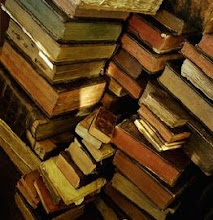

Bookcases

My Photo
Name:
Location: Zen&Tao Acoustic Cafe, Psychadaelia, Trinidad & Tobago

About me: Basically, I'm pretty much a snooze-button. I'll annoy you awake but if you punch me I'll let you sleep for another five minutes!

Wednesday, April 16, 2008

The Holy Man


Susan Trott

Riverhead Books,
New York
1995


A novella about a hermit who lives high atop a mountain, whose fame is so great that people stand in line for nine months out of the year to see him, and it seems that the book is actually an allegory for the different personality types that exist within the span of humanity, and also within each of us. Every one of the pilgrims is coming to see the Holy Man for the same reason, but they each approach it in a different way. Some can't stand the wait, some can, some try to cut in line - and one of the more insightful aspects of the book is the description of the culture that springs up from the line itself, how the people establish cetain rules and conditions, such as: no line-jumping, if you leave the line to go back into town you go to the end of the line - period (which actually helped cure one man of his alcoholism), and at the end of the day every body beds down beside the road for the night and everyone gets back into the same position in the morning.

There is even one lady who never gets to see the Holy Man, because she spends her time helping others in the line, helping to keep order, establish the guidelines, and because of this she is contantly jumping backwards in the line to help the newcomers, and in this way, she has actually found her niche in the world.

Some people do see the Holy Man - the majority of people he shuffles quickly through his house and sends them on their way with a bit of sound advice (by the way, it is Jesus's Second Commandment) and only a select few does he actually sit and converse with.

Without much more description, I hope that I have whetted your appetite enough to read it - it's really an endearing little book, and definitely one for the collection. Also a good one for a small gift - people need to be reminded of certain things these days, and how to comport ourselves with each other is definitely one of the guiding principles of this little book.


VG

The Apple That Astonished Paris

Billy Collins

University of Arkansas Press, 1988


Many of these poems, while exploring the usual themes of love, death, life, etc, always concurrently explore language. For Collins, language itself is a living, breathing entity, something to be courted, wooed, protected, and seduced. In that way alone, I think he will definitely be in the canon of the greats.

That, and he also had a great turn of phrase.

Here are two samplings:

Schoolsville

Glancing over my shoulder at the past,
I realize the number of students I have taught
is enough to populate a small town.

I can see it nestled in a paper landscape,
chalk dust flurrying down in winter,
nights dark as a blackboard.

The population ages but never graduates.
On hot afternoons they sweat the final in the park
and when it's cold they shiver around stoves
reading disorganized essays out loud.
A bell rings on the hour and everybody zigzags
into the streets with their books.

I forgot all their last names first and their
first names last in alphabetical order.
But the boy who always had his hand up
is an alderman and owns the haberdashery.
The girl who signed her papers in lipstick
leans against the drugstore, smoking,
brushing her hair like a machine.

Their grades are sewn into their clothes
like references to Hawthorne.
The A's stroll along with other A's.
The D's honk whenever they pass another D.

All the creative-writing students recline
on the courthouse lawn and play the lute.
Wherever they go, they form a big circle.

Needless to say, I am the mayor.
I live in the white colonial at Maple and Main.
I rarely leave the house. The car deflates
in the driveway. Vines twirl around the porch swing.

Once in a while a student knocks on the door
with a term paper fifteen years late
or a question about Yeats or double-spacing.
And sometimes one will appear in a windowpane
to watch me lecturing the wallpaper,
quizzing the chandelier, reprimanding the air.


Etymology

They call Basque an orphan language.
Linguists do not know
what other languages gave it birth.

From the high window of the orphanage
it watches English walking alone to the cemetary
to visit the graves of its parents,
Latin and Ango-Saxon.