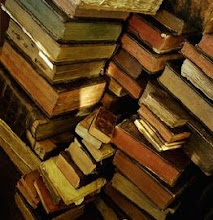

Bookcases

My Photo
Name:
Location: Zen&Tao Acoustic Cafe, Psychadaelia, Trinidad & Tobago

About me: Basically, I'm pretty much a snooze-button. I'll annoy you awake but if you punch me I'll let you sleep for another five minutes!

Monday, August 27, 2007

Brave New World

Aldous Huxley

This in the series of "Books I Should Have Read By Now"

and I have to say that I was rather disappointed in this one. It has some interesting ideas, certainly, and no, I wasn't shocked by the reduction of the rampant sexuality . . . and to be honest, I don't see where people get the idea that "soma" is a vision of "prozac" because prozac is not an hallucinogen . . . although I can see the similarity of the "calming" qualities.

Actually, now that I think of it, how the people took soma is sort of how people take prozac - like candy. Let me reverse the previous sentence: the book did envision that part of its future.

Still, though, I found it rather lacking in plot. I don't know. But, at least I can say that I've read it and now I can move on to the next in the series.

VG

Wake Up and Write

William Manners

a book about how to unlock creative powers and write prolifically. However, you can't get past the fact that it was written in the 1970's and the publishing advice is completely out of date.

Also, it's interesting to note the inherent sexism of the text. Now, I'm no diehard feminazi, but even I could see how the entirely "he"-dominated text completely ruled out any sort of contribution from a female author. Texts like this don't denigrate women; they simply ignore them into nonexistence.

However, the basic premise can truly be summed up (for writers of whatever gender) in these words: If you want to write prolifically,

then simply DO SO.

Start typing, and never give up.


VG

The Shape of Things

Edited by Damon Knight

Needless to say I loved it because it is a collection of stories from the 1950s Sci-Fi, which mainly centered around (or are influenced by) the atomic age. Mainly though, if I haven't stated it clearly before: I love science fiction from the mid-twentieth century - it's so honest and innocent. For example: the Bradbury story describing the birth of a baby . . . while machines in the future dominate the birthing process, the man is still in the lobby drinking gin martinis (from a vending machine, no less!) - I swear I could teach an entire class on Sci Fi in Retrospect: what the writers could foresee, and what the culture took so much for granted that it became an integral part of their work.

Besides that note, the stories in this collection were culled from two SF magazines: Startling Stories and Thrilling Wonder Stories, and represent the apex of the SF that those 'zines produced.

Some of the stories:
Henry Kuttner "Don't Look Now" (supposed to be "twist" ending, but when you're looking for it - it's easy to spot. However, seems to be a predecessor to the movie They Live.
James Blish "The Box"
Charles L Harness "The New Reality" (now that ending really surprised me, and was very well done - had an almost CS Lewis quality to it)
Murray Leinster "The Eternal Now" (time -stopping : there was one point in which I felt the science wasn't precise, but it would be good for a classroom discussion)
Theodore Sturgeon "The Sky Was Full of Ships" (not his best work, but a great idea)
Ray Bradbury "The Shape of Things" (another example as to how Mr. B is the absolute master of blending the utterly human with the science of fiction)
L Sprague De Camp "The Hibited Man" (very funny! )
A E Van Vogt "Dormant" (seems like a good idea but rather convoluted and poorly written - the shifting voice from omniscient narrator to creature could have been done with much more aplomb)
Anthony Boucher "The Ambassadors" (one of the strongest stories - and the shortest in the collection - reads like an overview, but brings together disparate elements in a new way)
John MacDonald "A Child is Crying" (probably one of the best stories - in what it suggests and in characterization of the mutant)

Again, I firmly believe there was no better SF written than during this time period, when the dawn of the atomic age launched SF into the field of science's ability to kill us all, which made each of these writers focus on the struggle between the almost god-like power of humankind to destroy ourselves and our own inherent frailty as human beings, our frailties tempered somewhat by our ideals.

VG