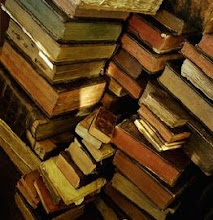

Bookcases

My Photo
Name:
Location: Zen&Tao Acoustic Cafe, Psychadaelia, Trinidad & Tobago

About me: Basically, I'm pretty much a snooze-button. I'll annoy you awake but if you punch me I'll let you sleep for another five minutes!

Friday, December 14, 2007

Edmund and Rosemary Go to Hell

Bruce Eric Kaplan

(c) 2007 Simon and Schuster

very writty

(I mistyped that, but before I erased it I read it again and liked it, because it seems to be appropriate: "writty" - possibly a comalgamation of "wry" and "witty")

but for all the metaphysical implications, that of all of being in Hell, meaning, the Earth IS Hell, at the end of the day, it has something extremely important to say about love, about relationships, about what we really mean to each other.

Very very very well done.

VG

Thursday, December 06, 2007

Hopper

by Mark Strand


Ecco Press, 1994


I was deceived. This book appeared to me to be the third in the style of two other biocriticisms that I've read, one by Charles Simic about Joseph Cornell (posted on this blog), which explores his art and bio through the lens of prose/poetry, and another in a similar vein, though slighlty more standard, by Joyce Carol Oates about George Bellows (which I should have blogged but apparently have missed). Both of those opened a new world for me, a person for whom art criticism has always seemed pretentious and for whom the "biography" has been - frankly - dull.

Like I said, though, when I saw Strand's book on the library shelves it LOOKED like the other two looked. Same size, same depth, same cover design, same interior layout.

Maybe I've started off with too harsh a comparison for this book - it IS good, and it does invite you to explore the works of Edward Hopper with an eye toward not only his contemporary influences but with regard to his view of America in general and his ideas about art as a passion and a craft.

But I just expected it to be more . . . poetic. Like the other two.

Perhaps what intrigues me about Hopper's paintings is that, at the end of the day, they are so unlike all the other art at the time, which seemed to paint a self-conscious romanticism. Hopper's paintings reveal characters and places that seem to be resigned to desperation - accepting their helplessness with as much quiet dignity as they can muster.

In short, there needs to be a book about Hopper written in that style. Maybe one in which uses his paintings as leaping points for literary character sketches, vignettes, or even complete stories.

I think I've just talked myself into a project.

VG