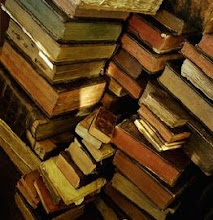

Bookcases

My Photo
Name:
Location: Zen&Tao Acoustic Cafe, Psychadaelia, Trinidad & Tobago

About me: Basically, I'm pretty much a snooze-button. I'll annoy you awake but if you punch me I'll let you sleep for another five minutes!

Friday, September 23, 2005

Black Misery

Black Misery, by Langston Hughes. Illustrations by Arouni. Introduction by Jesse Jackson, and an afterword by Robert G. O'Meally. Oxford University Press, New York 1994.

Written in 1967, and half-completed at the time of his death, this work reminds me so much of the little Peanuts books that I got for my kids in the 70's, those little "Happiness is a Warm Puppy" booklets - with a simple thick-lettered sentence on one page and a cartoon on the opposite.

But Black Misery was the "flipside" of the feelgood books, and I'm amazed that I missed it when it came out in '69-'70. But this edition was very edifying, especially good also for the introduction and the afterword, which had wonderful info about the time AND the poet himself. Made me want to go find my copy of Best of Simple. (think I'll clean out the attic looking for it this weekend!)

In all honesty, this is not a children's book so much as a document of a time of integration; it's a very straightforward, simple text that cuts to the heart of the matter - revealing how difficult it can be to force two cultures together when they had been kept apart. What's great about reading it 35 years after the fact is that we can see how much has changed. For example, the phrase "Misery is when you start to play a game and someone begins to count 'eenie, meenie, minie, mo . . . " which used to continue with "catch a nigger by the toe," and I don't know if kids these days even use that any more, but I recall with fondness one summer afternoon in 1977 listening to my own children in the backyard with some friends and they used the same phrase, only it continued with "catch a TIGER by the toe."

Obviously the change of just one word, but at least I knew that moment that something had changed for the better - there was no implied or subliminal racism in that chant - not from then on. and that, for me, was like a breath of fresh air.

The book ends with "Misery is when it takes the whole National Guard to get you into the new integrated school."

Strong words, bringing back stinging memories to anyone who lived through that time. And for the 35% of the population who has no memory of that, I say bless their little heads because they never knew about segregated swimming pools, or bathrooms, or water fountains.

The world is not a perfect place. But in many ways, it is a better place. And it takes a "kid's book" like Black Misery to remind us of that.

The only sadness I feel is that Mr. Hughes didn't live long enough to see it. He didn't even make it to 1977, at which time he could have heard a generation growing up on "tiger."

Bless you, Mr. Hughes, and thank you, once again.

VG

Wednesday, September 14, 2005

Scum Manifesto

Whoa!

That's the expression that any male should have if they attempt to read this . . . sociological study on obsession with - well, frankly, "gender-cide."

Valerie Solanas was not simply having a bad day, and she didn't JUST have a bad attitude. Whicever way you try to slice it: she wanted men DEAD. We're not talking just the "joking around - wouldn't it be nice if all guys dropped off the face of the earth ha haha!" - No. We're talking - she wanted to take the boxknife and kill ALL men.

I believe in what Oscar Wilde wrote: There are no moral or immoral books. Books are either well-written or poorly-written, that is all. But SCUM Manifesto comes very close to being immoral, in my book (pardon the pun).

I suppose I should be grateful that this little treatise IS the poorly-written ramblings of a disenfranchised feminist-hippie who was, frankly, artistically spurned by Andy Warhol, and so earned herself the barest footnote in history by being the person who shot him. Perhaps she would have earned even more notoriety had she actually succeeded in killing him, but that would be pure supposition.

I don't want to give this nasty little work any more thought than I should: but to be fair I feel I must report that her ideas are scattered, they use the barest of scientific evidence (the X/Y chromosome being proof that men are "failed" women - developmentally speaking), and she contradicts herself page after page.

Perhaps the most frightening aspect about this book is the introduction by Avital Ronnell (which is almost as long as the Manifesto proper) because it actually holds this pile of tripe up as a bona fide social document. She actually dissects the SCUM Manifesto as though it were an important work of literature, destined for the canons of human thought. Basically, this just shows you what an English degree can give you - the power to make a dialectic out of a dung heap.

And this is not just be "being an oppressive male" wanting to extinguish the female voice - this is an offended human being who is against wholesale slaughter of a segment of the population.

Last facts: written in 1971. However, the edition that I am now gladly returning to the public library was (c) 2004, Verso Press, London.

SCUM: Society for Cutting Up Men.

Kinda makes you wince, don't it?

Monday, September 12, 2005

Snow

Snow. Fermine, Maxence. Atria Books, New York. 1999

Surprisingly good - when I started reading it I thought morosely, "Oh joy. A watered down Marguerite Duras." But I found myself breezing through it as - and there's no way to avoid the allusion - as lightly as a snowflake.

Yes, it's a light book. A light read. Yes, it breaths like haiku. All this is true. It also is a very nice little love story, with, yes, a happy ending which tries to be surprising (but isn't) but that's OK. Because you like this little book - you like Yuko the haiku poet whose haiku are completely white and need colour, you like Soseki the blind painter who sees true colours now that he has lost his sight, and you also (like these two men) fall in love with the dead woman trapped underneath the ice.

I know that last phrase may sound morbid, but it isn't. Read the book - you'll like it despite yourself. And yes, you'll have the images of managa comics (or the Japanese cartoons) - maybe you'll imagine the scene in the garden between the two warriors in The Last Samurai. Maybe you'll think of the snow falling scene between Lucy Liu and Uma Thurman in Kill Bill Vol. 1.

My word! Going from a peaceful, heartwarming, love-affirming book to a Quentin Tarantino bloodfest. Now there's a Huntian extrapolation for ya! But in both movies mentioned there are scenes of immense peace - beauty - tenderness. That's what this book is throughout.

Lastly, while I've already made the Duras reference - his style is similar, but she's got more "meat on her bones" so to speak, and tons more emotional baggage. This book took her straightforward and tender style and gave us a morality tale as tender (though not as all-encompassing) as The Little Prince. Ergo - a haiku that is unabashedly French.

Basically, this is a book to read to your loved one/parter/whatever you call'em by candlelight just before you fall asleep in each others' arms.

Trust me!

VG

Friday, September 09, 2005

A House Called Awful End

Honestly, I had to google A Series of Unfortunate Events to see when the first book in that series had been written, in order to determine if this book was simply a cheap knock-off.

To be fair, Awful End isn't a bad book - it's just that, when you've been reading the Snicket books, you rather have that style in your head, comparisons result, and you instinctively judge one based on the other. Both of these series are for young adults, both derive their humour from their dreary scenarios, both have an omnipresent narrator who likes occasionally to stray from the story or interject a certain detail. And both appear to be very British.

The only difference, you might say, is that Events is set after the invention of the automobile and Awful is definitely prior. However, I feel now I must ignore the comparisons and give you my humble opinion on this book properly. Here goes:

A House Called Awful End: Book One of the Eddie Dickens Trilogy. Ardagh, Philip. Henry Holt and Company, New York. 2000. (Is my citing getting better? I still haven't found my MLA Handbook - it's hidden/lost somewhere among the dusty shelves!)

Basic plot: Eddie's nutball parents send him to live with his nutbar uncle&aunt who are convinced by a nutty actor to put him in an orphanage run by nutcases. The only sane character is a stuffed stoat. Eddie finds a way out of the orphanage - the parents come to their half-senses - and everything ends on a quasi-steady stalemate.

I looked at Ardagh's bibliography and he seems quite an accomplished writer - something like 4 books per year, starting in 1995; it seems as though this was his first work of fiction, the others being history books. I have to admit I'd like to check some of those out, because his lighthearted style in Awful End would certainly lend itself to some humourous recounts of historical yarns (I love history books pretty much ONLY when they are told either behind-the-hand, tongue-in-cheek, or downright sarcastically!)

But OK I can't stand it any more!!!! YES!!! this STILL reads like a "poor man's"-Series of Unfortunate Events. I'm sorry, Mr. Ardagh - I can't get away from it. Snickett's books started in 1999, these in 2000. I'd like to think that this is all sort of a Jungian Collective Unconscious-thing, i.e. both writers were operating in a wholly separate vacuum and just happened to come up with similar books at the same time . . . but I don't know how far I can stretch that theory.

I suppose I could just admit that I like BOTH series and let it go with that. And kudos to both authors - my favourite part of both books is that many characters are named after 19th Century Authors (Eddie DICKENS, the BEAUDELAIRE orphans, etc.) - Neat job, guys! er . . . I mean, jolly good!!

VG

Thursday, September 08, 2005

Legends, Lies and Cherished Myths of American History

Just finished this book last night while I lay curled up on the couch because my third (or is it fourth?) wife had edicted that there was where I shall pass the midnight hours (for reasons too esoteric to expound upon here - not that you'd care anyway, but still . . .)

Legends, Lies and Cherished Myths of American History, by Richard Shenckman (c) 1988 William Morrow and Co. Inc, New York. 1988. (I believe I need to check my MLA Handbook for information on how to correctly site sources - it's been ages since I've been to college - and by "ages" I'm talking Industrial Age, Middle Age, Dark Age, Bronze Age . . . ) Regardless, I finished the book and fell asleep with it open on my chest, as though the book were a blanket of paper, which is one of the most fulfilling and satisfying happenings in life, and awoke with a terrible crimp in my neck.

But all that is beside the point. The book's a quick read, very bright, very pithy. What's strange, though, is that it's dated. I mean, for a history book that mainly centers around the Revolutionary and Civil Wars to seem dated was very strange for me - but you could tell that it was written during - and FOR - the Reagan era (that's the 1980's for all you history majors out there!)

How could that seem dated, you say? I can't explain, but it's true. Certainly the tone was in a very smooth style, like someone who had really done his research and was very excited about spreading around the knowledge - not truly pedantic or condescending in any way, absolutely not - the author genuinely enjoys debunking popular myths about who we think we are and from what stock of people we think we've come. And that was the main "jist" of the book, and had Shenckman been a psychologist or sociologist instead of a reporter, he probably would have droned on and on for chapter after chapter about "healing processes" and "unconscious reactionism" or some such drivel.

However, being a reporter - he just gives us the facts, and happily throws in an opinion or two along the way.

Like I said - a good read, but you can definitely tell that it ends in the 80's. Which for some reason makes it seem overly quaint.

Not that I understand what that's supposed to mean or anything, I'm just . . . well . . . hopefully I'll understand better tomorrow after I get a good night's sleep. (Keep your fingers crossed for me, wouldya?)

VG

Thursday, September 01, 2005

Personal Library

If you open the door to my private library, you will enter a room where the bookcases extend from floor to ceiling, around every wall save for the door itself and the large window that lets in the light from the morning sun as it crests the Atlantic Ocean. The room itself is two stories high, and I have created a series of sliding ladders and trellises to enable any relatively able-bodied person to peruse the various shelves for whatever tome they might happen upon.

I have painstakingly put together this collection of tomes, and indeed taken care in designing this room and its various shelving units, in order to display and maintain this library with the utmost efficiency and comfort.

I would like to invite you into this library, to wander, to roam, to mill about. But most importantly, I invite you to either find something you would like to read, or bring to me a book of your choosing. Don't be concerned with what you think I might like, tell me what you think is something that I should read.